
Why give The Shoe That Grows?
$0
$0 MATCH REMAINING
$70000
Remove a barrier to education. Give The Shoe That Grows.
Education is key to breaking the cycle of poverty, and a simple pair of shoes is a tangible way to make education more accessible to children and families who face many challenges. Shoes meet a uniform requirement, protect from disease and injury, and promote dignity and equality—making it easier for kids to get to school and attend regularly.
During Shoes For School 2026—thanks to several generous matching gifts—every $10, up to $35,000, provides TWO pairs of The Shoe That Grows to schoolchildren in Kenya and supports mission-critical operations.

$10 sends 2 pairs
Two Because supporter organizations—a generous anonymous donor and our long-time partner Gordian Staffing—are committed to making education more accessible for kids in Kenya through The Shoe That Grows. Together they have pledged $25,000 in matching dollars so that your gift of shoes can go twice as far.
*Update: Your generosity is inspiring! Thanks to all your support, and in an effort to ensure everyone's gifts are doubled, two more donors stepped forward during the last day with additional matches to help us get shoes to 7,000 kids!*
Will you help us use every dollar to fund pairs of shoes for back-to-school distributions? Your gift of any size—now up to $35,000—will be doubled to benefit kids in rural Mandera County and urban schools in the Mukuru informal settlement of Nairobi.

Grows five sizes, lasts for years
The Shoe That Grows is a shoe that adjusts in four places to expand five sizes, protecting a child's feet longer than any other shoe can.

Removes a barrier to education
A pair of shoes meets immediate needs like protecting health and reducing a financial burden, making it easier for kids to pursue education.
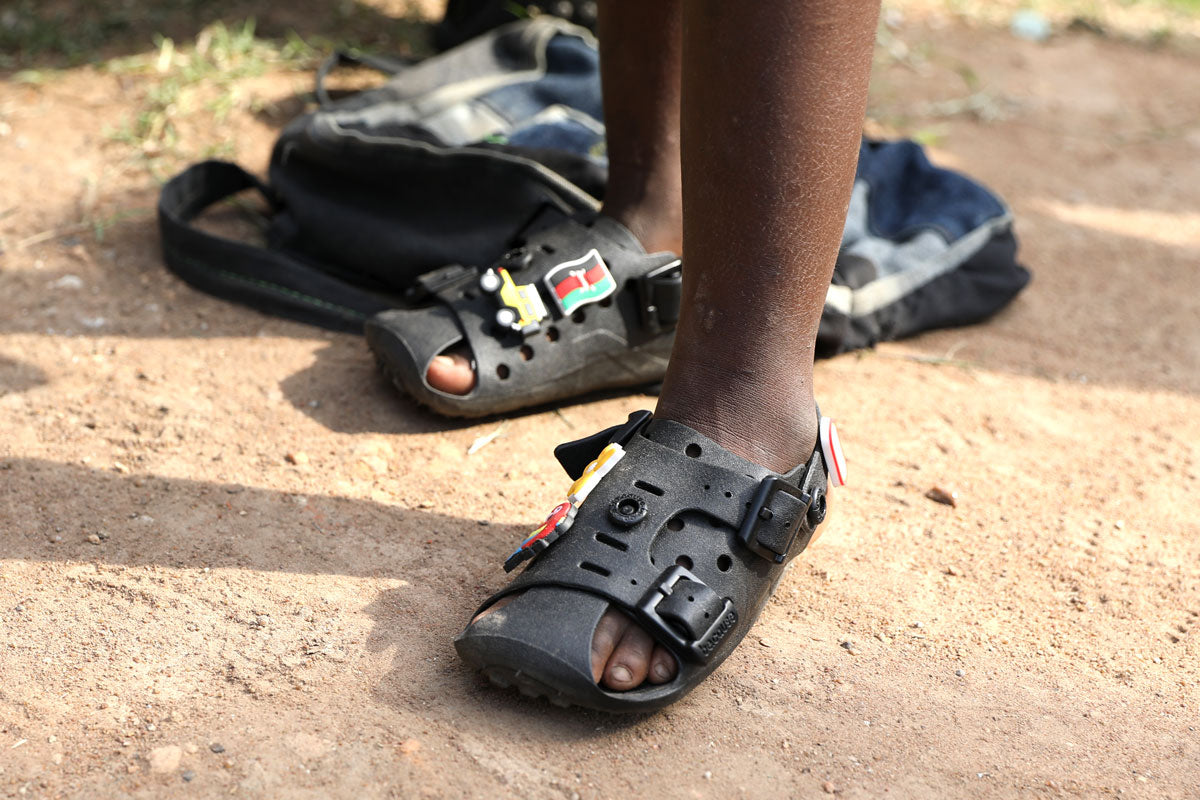
Patented, award-winning design
2018 recipient of The U.S. Patent and Trademark Office Patents for Humanity Award. Featured in publications including The Today Show, Buzzfeed, Smithsonian, Business Insider and more.
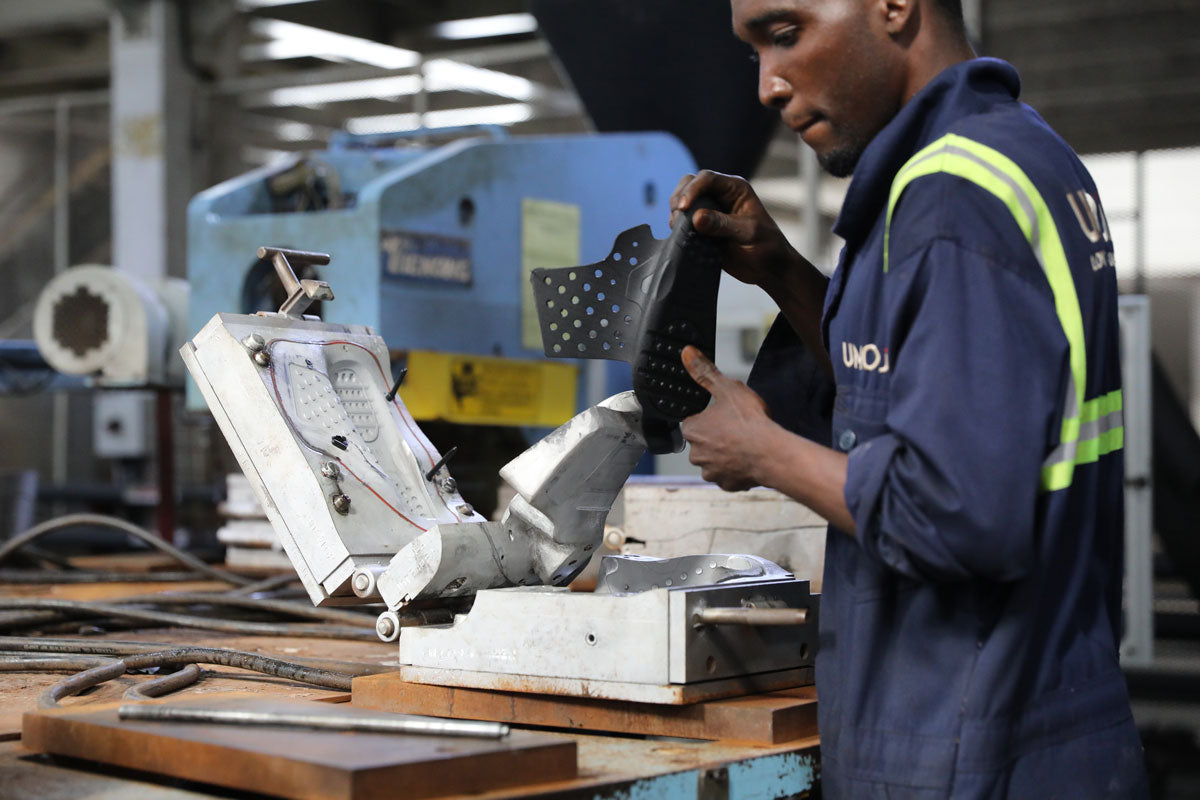
Made in Kenya
Since 2019, all pairs of The Shoe have been manufactured in Mombasa, Kenya—creating jobs in one of the communities where its distributed most.

Partnering with Jaguar Foundation
Serving kids in the Mukuru informal settlement
In Nairobi's densely packed settlement corridors—Mukuru Viwanda, Mukuru Nyayo and South B—the walk to school means navigating broken glass, exposed metal and raw sewage. Because International's partner here, the Jaguar Youth Empowerment Foundation (JYEF), surveyed students at three schools so far and found that every child interviewed knew someone with jiggers, nearly all had been injured walking barefoot and most named shame, not just injury, as their biggest fear—as one student put it, "Some people laugh at me and call me poor."

Partnering with OSDA
Serving kids in Mandera County
Mandera sits at Kenya's remote northeastern edge, bordering Ethiopia and Somalia, where children walk to school across ground that bakes in the sun, through paths lined with thorns, sharp stones and scorpions. Because International's partner in the region, the Organization for Sustainable Development Africa (OSDA), surveyed nine schools here for a first phase of distributions—including two special schools serving deaf and blind students—and found a consistent pattern: nearly every child surveyed regularly walks barefoot, knows someone with jiggers and has been injured on the walk to school in the last six months.

Protect feet
From parasites and disease
Build confidence
And improve self-esteem
Remove barriers
To help kids attend school
Elevate communities
Through education

Learn more about the impact you're making.
-
The Shoe That Grows is a shoe that expands five sizes, designed for children impacted by poverty. Since launching, more than 600,000 pairs have been distributed in 100+ countries.
-
While at least a million kids in Kenya lack appropriate footwear, one 2017 study of only public school children estimated 600,000 have no shoes at all. Without protection on their feet, they are left vulnerable to soil-transmitted diseases, parasites, and injuries that can lead to infection. Your donation of The Shoe That Grows will help provide kids in Kenya with a pair of expanding shoes, protecting their feet for years as they grow.
-
A pair of shoes meets immediate needs like protecting health and reducing a financial burden, making it easier for kids to pursue education.
-
Because International’s story began in Kenya when our founder met a little girl in a white dress who was wearing shoes much too small for her feet. Inspired to create a shoe that could grow with a child, The Shoe That Grows was born. Since then, we’ve continued to work within the country through manufacturing at the Umoja Shoe Company in Mombasa and shoe distributions.
While at least a million kids in Kenya lack appropriate footwear, one 2017 study of only public school children estimated 600,000 have no shoes at all. No protection from jiggers, hookworms, puncture wounds, sores and infection. So, given our passion for the community there and our ability to distribute pairs easily from the factory, we decided to continue working within the country that means so much to our mission and founding story. This campaign supports our commitment to reduce the number of kids in Kenya who need shoes. -
100%. For every $10 you donate, we will distribute two pairs of The Shoe That Grows to a child until we exhaust the match. Then every $10 will provide a pair.
